

The sex-doll industry has changed considerably over the past two decades. What was once dominated by relatively simple inflatable products has evolved into a global market featuring realistic silicone and TPE bodies and highly customized designs. Just like with the Trans Escorts niche, the transsexual sex dolls also arose.
One of the more distinctive developments has been the appearance and expansion of transgender sex dolls: products designed around bodies combining traditionally feminine and masculine sexual characteristics.
But an important question remains: are transgender dolls actually becoming a larger part of the sex-doll market, or are manufacturers simply offering more models because production and online distribution have made niche products easier to sell?
The available data provides some interesting clues, although it does not yet provide a definitive answer.
From novelty product to specialized category
The modern sex-doll market grew alongside improvements in materials and manufacturing. Thermoplastic elastomer (TPE), silicone, articulated metal skeletons and increasingly realistic molds allowed manufacturers to move away from the crude designs associated with older inflatable dolls.
The broader market is now substantial. Grand View Research estimates that the global sex-doll market will reach approximately $13.4 billion by 2033, with a projected compound annual growth rate of 9.3% between 2026 and 2033. Its analysis also identifies TPE as the largest material segment, accounting for 50.61% of revenue in 2025.
Other market researchers produce considerably different estimates, illustrating one of the central problems with studying this industry: there is no universally accepted methodology or transparent global sales database. Mordor Intelligence, for example, reports that TPE dolls represented 56.48% of revenue in 2025 and that full-body dolls represented 63.49%.
These figures should therefore be regarded as industry estimates rather than official statistics.
Within this expanding market, manufacturers have increasingly experimented with specialized body types. Transgender dolls are one example.
Are transgender dolls actually selling more?
There is evidence that demand exists and has recently increased, particularly online.
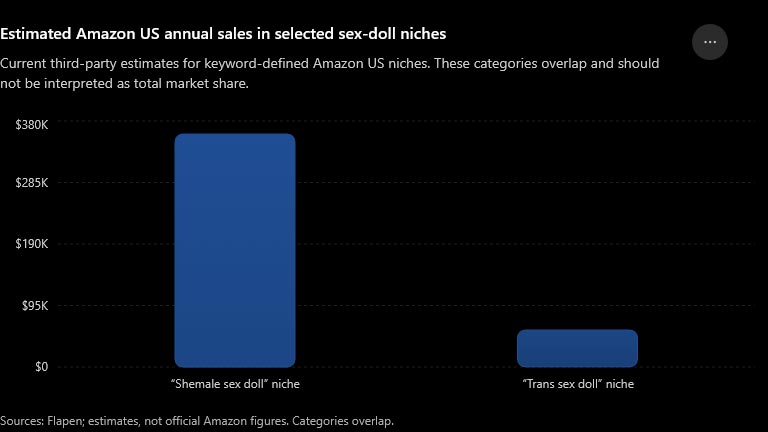
One current analysis of Amazon US search and sales data estimates the annual market associated with the search category “Shemale Sex Doll” at approximately $360,000, based on roughly 1.1 million searches during the previous 12 months. The same analysis reports that search demand increased by 6.8% over the preceding 90-day period.
Another Amazon-focused analysis isolates the more specific “Trans Sex Doll” search category. It estimates approximately $57,000 in annual sales, around 1,000 units per year and 187,000 annual searches, with search demand increasing 3.9% over the most recent 90 days.
These numbers are interesting, but they require an important warning.
They are not equivalent to the entire transgender sex-doll market. They are estimates associated with particular Amazon search categories. They also cannot simply be added together because the keywords overlap. Furthermore, many products are sold through specialist manufacturers, independent websites and other marketplaces.
Still, they demonstrate something useful: transgender-oriented sex dolls are not merely hypothetical products with no measurable consumer demand. They form a commercially identifiable niche.
The broader market is growing too
There is another important part of the story.
The growth of transgender dolls should not automatically be interpreted as evidence that consumers are abandoning conventional female sex dolls.
The broader market is growing as well.
Amazon US data compiled by ASINsight, for example, estimated that the top 50 products ranking for “full size sex doll” generated approximately $3.17 million in sales during the 12 months ending July 2026. Sales in July alone were estimated at 3,150 units, worth approximately $454,552. That represented a 57.5% increase compared with August 2025.
Interestingly, one transgender-oriented product appeared among the top products tracked for the broader “full size sex doll” category. The listing was estimated to have sold approximately 200 units during July 2026.
That does not establish the market share of transgender dolls, but it does demonstrate that transgender-oriented products can compete within the general sex-doll marketplace rather than existing entirely in an isolated niche.
A market-share problem
So, have transgender sex dolls increased their market share relative to conventional heterosexual dolls?
At present, there isn’t enough publicly available data to calculate this reliably.
There are several reasons.
First, manufacturers and retailers generally do not publish sales broken down by the customer’s preferred sexual orientation or by the gender identity represented by the doll.
Second, terminology is inconsistent. A retailer may classify a product as a “trans doll,” “shemale doll,” “male/female doll,” “doll with penis,” “futanari doll,” or simply place it alongside conventional female dolls.
Third, search behavior and actual purchases are different things. A keyword receiving hundreds of thousands of searches does not mean that hundreds of thousands of people bought a product.
Consequently, the available data supports the conclusion that the transgender-doll niche has measurable and apparently growing demand, but it does not support a precise statement such as “transgender dolls now represent X% of all sex-doll sales.”
That distinction is important.
Are there more buyers, or simply more models?
This is probably the most interesting question.
The increase in the number of transgender models may itself be part of the explanation for the apparent growth in the category.
Online commerce dramatically reduces the cost of serving niche markets. A physical store might have little incentive to dedicate shelf space to an unusual product that appeals to a relatively small audience. An online manufacturer, however, can list hundreds of variations and reach customers internationally.
The current Amazon data illustrates this diversification. The “Trans Sex Doll” category tracked by Flapen contained 22 products from 18 brands, while the broader “Shemale Sex Doll” category contained 27 listings from 21 brands.
That means an increase in the number of available models does not necessarily prove that the underlying population of buyers has increased proportionally.
It may simply mean that manufacturers have become better at identifying and serving smaller groups of consumers.
In other words, market fragmentation can look like market growth.
Are sex-doll customers the same people who hire transgender escorts?
There is currently no good evidence that allows researchers to answer this question directly.
Studies of clients of transgender sex workers tell us something about that market, but they do not track whether those same individuals purchase sex dolls.
A study of transgender women sex workers and their male clients in Lima, Peru, found that the clients were primarily bisexual or heterosexual: 54% identified as bisexual and 41% as heterosexual, while only 4% identified as homosexual.
That is an important finding because it demonstrates that interest in transgender women cannot simply be equated with identifying as gay or transgender.
But it still doesn’t tell us whether these men subsequently purchase sex dolls.
Research into commercial-sex networks similarly demonstrates that some clients interact with different categories of sex workers. A 2026 study using more than 1.4 million client-sex-worker links from an online review platform found that clients who reviewed both cisgender and transgender female sex workers represented a minority of clients but accounted for a substantial share of transgender-related reviews.
Again, however, this is evidence about sexual-service consumption, not sex-doll purchases.
The two markets may overlap, but there is no solid evidence establishing how much.
Has LGBT visibility influenced the trend?
This is where the discussion becomes more complicated.
It would be reasonable to hypothesize that greater visibility of transgender people and greater cultural familiarity with gender diversity could make consumers more comfortable searching for products that represent transgender bodies.
But a hypothesis is not the same as demonstrated causation.
The growth of transgender sex dolls coincides with several other developments: the expansion of e-commerce, improvements in manufacturing, increased privacy through home delivery, more sophisticated adult-product marketing, improved materials, and the general expansion of the sex-toy market.
It is therefore impossible to look at the available sales numbers and conclude that LGBT activism or an “LGBT agenda” caused the increase.
There is also a reverse possibility: manufacturers may simply be responding to demand that already existed.
The relationship could therefore be circular. Greater visibility may encourage some consumers to explore products, while consumer demand encourages companies to produce more models, which in turn makes those products more visible.
The evidence currently does not allow us to assign a percentage of the growth to any one of these factors.
The bigger change may be consumer segmentation
Perhaps the most significant evolution is not specifically transgender.
It is the transformation of the sex-doll industry from a market based around a small number of standardized fantasies into a market increasingly based around customization and segmentation.
Today’s consumers can select body proportions, skin tone, hair, facial features, breast size, genital configuration, materials and accessories.
From a commercial perspective, transgender dolls fit naturally into this development.
They are one more example of manufacturers recognizing that consumers do not all want the same representation of a sexual partner.
The broader market research supports this interpretation. Industry analysts increasingly describe customization, more realistic materials, direct-to-consumer websites and increasingly sophisticated products as important drivers of the sex-doll market.
What can we actually conclude?
The available evidence suggests three things.
First, the broader sex-doll market is growing. Multiple industry estimates predict substantial growth during the next decade, although the exact size varies significantly between research companies.
Second, transgender-oriented sex dolls represent a real commercial niche with measurable online demand. Current Amazon-focused estimates show hundreds of thousands of dollars in annual sales associated with relevant search categories and recent increases in search demand.
Third, there is not enough public evidence to establish their exact market share, their historical share, or whether their buyers are the same people who purchase transgender escort services.
The most defensible interpretation is therefore not that transgender sex dolls have “taken over” the market, nor that their growth is entirely the result of changing cultural politics.
Instead, the evidence points toward a broader transformation: as sex dolls become more realistic, customizable and accessible through online commerce, manufacturers are increasingly able to serve specialized sexual interests that previously would have been too small for a mass-market product.
Transgender dolls appear to be one of those niches.
Whether their share of the total market continues to rise will ultimately depend less on the number of models manufacturers release and more on whether the underlying consumer demand continues to expand.
